Glob Top Encapsulation: 6 Rules for COB Dispensing
Glob top encapsulation is the process of dispensing a bead of filled resin over a bare die and its wire bonds until the die is buried under a smooth dome of cured material. It protects the most fragile part of a chip on board assembly without a package, and it replaces the moulding that a conventional component would carry.
The process looks simple and is not. Shape, coverage and cure all interact, and a glob that looks acceptable on the bench can trap voids, stress the wire bonds or pull away from the die surface a few thermal cycles later. This guide covers the parameters that decide whether the dome survives.
What Glob Top Encapsulation Has to Do
The dome has four jobs: keep moisture and contamination away from the die surface, hold the wire bonds in place, absorb mechanical and thermal stress, and survive the soldering and cleaning steps the assembly still has to pass. Each job pushes the material choice in a different direction.
It also has to stay inside its own footprint. The glob must cover the wire loops without flowing onto adjacent pads or under neighbouring components, which makes the rheology of the resin as important as its electrical properties. Resin that creeps onto a neighbouring pad can also disturb the soldering of parts placed later.
The Chip on Board Assembly Under the Glob
Everything under the resin decides whether the encapsulation works. Die attach voids, contamination on the bond pads and wire loops that stand too high all become permanent defects once the glob is cured, because the material locks the fault in place. Coverage is judged at the wire loop rather than at the die, since that is where the resin ends up thinnest.
That is why the assembly sequence in chip on board assembly design has to be settled before the dispensing recipe is written. A process that dispenses before the wire bond position is stable will produce globs of varying height across the panel.
Choosing the Encapsulant
Encapsulant viscosity sets how far the bead spreads before cure and how well it wets the surfaces it must cover. A low viscosity material flows around the wires easily but can run past the intended boundary, while a high viscosity material stays where it is placed and may bridge gaps without filling them. Thixotropic materials behave differently again, because their viscosity depends on how recently they were sheared in the syringe.
Filler content and thermal expansion matter for the same reason. A filled resin expands less than the silicon and the laminate, and matching expansion to the substrate reduces the stress the dome applies to the wire bonds during thermal cycling.
Dam and Fill Versus a Single Dot
A dam and fill layout dispenses a high viscosity dam around the die area first, cures or gels it, and then fills the reservoir with a lower viscosity resin. The dam holds the boundary so the fill can be optimised for flow rather than for staying in place.
A single dot is faster and needs less equipment, and it works well where the area is small and the boundary is far from other features. The choice usually follows the die size and the clearance available, and the dispensing technique shares equipment with underfill dispensing in many shops.
Dispensing Parameters That Decide the Shape
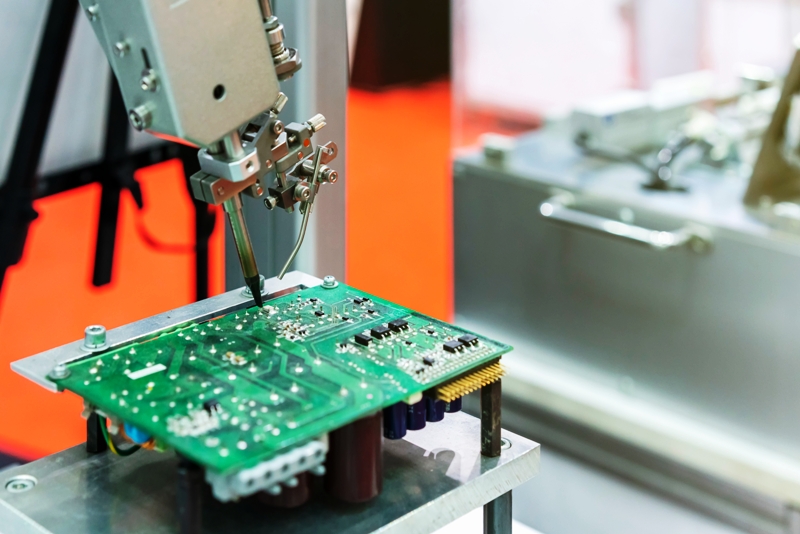
Needle size, dispense pressure, time and the movement of the head all shape the bead. A path that starts at the centre and spirals outward lets the resin flow over the wires from the die outwards, which pushes air ahead of the front instead of trapping it under the loops.
Height is controlled by volume, not by pressure alone. Dispensing the same weight at a different temperature gives a different dome, so the reservoir temperature and the time since mixing should be recorded alongside the program. A nozzle carrying partly cured material at the tip delivers a smaller bead at the same pressure, which is one of the most common causes of a short dome.
Cure Profile and Stress
The cure profile controls how fast the resin stiffens and how much it shrinks while it does so. A slow ramp lets the material relax before it gels, and a fast ramp freezes stress into the dome that appears later as wire sweep or die cracking.
Post cure is often required to reach the final properties, and it has to be run as part of the qualified recipe. Where the assembly also carries a conformal coating, the two cure schedules interact, as discussed in coating adhesion testing for coated boards.
Voids, Bubbles and Outgassing
Air enters the resin from mixing, from the syringe and from the surface it is dispensed onto. Large bubbles that sit over a wire loop leave the wire unsupported, and small voids near the die edge can seed a crack when the assembly heats up. Bubbles also collect where the resin meets a vertical wall, such as the side of the die or a tall wire loop.
Vacuum degassing before dispensing and controlled storage remove most of the entrained air. Material that has absorbed moisture also releases it during cure, and the wider problem is described in PCB outgassing control work.
Mechanical and Thermal Reliability
The dome has to survive thermal cycling without lifting at the interface or pulling a wire bond sideways. Adhesion to the die passivation, the wire and the laminate all have to hold, and the weakest of those interfaces sets the limit.
Board handling after cure matters as well. A stiff dome on a thin board concentrates bending stress at its edge, and the measurement techniques used in board strain measurement show whether the handling limit has been exceeded.
Inspection, Rework and Records
Inspection is visual and dimensional: coverage of the die and wires, absence of exposed loops, boundary position and dome height. X-ray adds little for a transparent resin, although a section through a finished part confirms void level and interface quality.
Rework of a cured glob is rarely economic, so the process has to be right the first time. The record should carry the material lot, the mix and degas time, the dispense program, the cure profile and the inspection result, so that a drift can be traced to its cause. Where the specification follows a published method, such as the assembly documents issued by IPC, that standard should be named in the record so results can be compared between sites.

FAQ
How thick should a glob top be? The dome only needs enough material to cover the highest wire loop with a margin above it, usually a fraction of a millimetre, plus the edge taper that the resin forms naturally. Extra height adds stress without adding protection.
Why use a dam instead of a single dot? The dam gives the fill a fixed boundary, so the resin can be chosen for flow and wetting instead of for staying in place. It costs an extra dispense and cure step, which is worth it on large or closely packed dies.
Can a cured glob top be removed? Only with difficulty and at high risk to the die and the wire bonds. Rework usually means scrapping the assembly, so coverage, void level and cure should be verified on a first article before a lot is run.