High-Reliability PCBs for Robotics
As robotics continues to evolve toward greater intelligence, flexibility, precision, and autonomy, the High-Reliability PCB for Robotics has become an essential part of the system architecture. A robot’s sensing, computing, motion control, power management, and communication functions all depend on reliable circuit boards.
Unlike conventional consumer electronics, robotic systems often operate under continuous motion, vibration, temperature fluctuations, electromagnetic interference, dust, oil, and other demanding conditions. Therefore, Robotics PCB Manufacturing must address both electrical performance and long-term mechanical reliability.
A properly engineered Industrial Robot PCB can help maintain signal integrity, power delivery, mechanical stability, and consistent operation throughout the equipment’s service life.
For projects requiring advanced fabrication technologies, PCB Manufacturing can include multilayer construction, HDI, controlled impedance, blind and buried vias, heavy copper, flexible PCB, and rigid-flex PCB technologies.
Why Do Robots Require High-Reliability PCBs?
Robots are used in industrial automation, warehouse logistics, medical equipment, inspection systems, collaborative applications, and specialized environments. Their PCBs must continuously support functions such as:
- Motor and servo control
- Sensor data acquisition
- Machine vision
- Wireless and wired communication
- Power management
- Safety monitoring
- Real-time computing
- Position and motion control
A PCB failure in any of these areas can cause inaccurate movement, communication errors, unexpected downtime, or even equipment safety issues. This makes reliability a fundamental consideration from PCB material selection through final inspection.
Key PCB Requirements for Robotic Applications
1. Strong Environmental and Mechanical Reliability
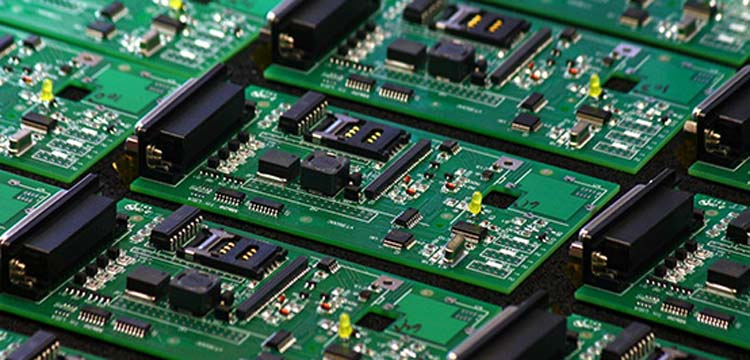
Industrial robots, robotic arms, and AGVs are frequently exposed to vibration, mechanical stress, temperature variation, and continuous movement. The PCB must therefore maintain its structural integrity during long-term operation.
A carefully designed multilayer structure can help control board deformation and mechanical stress. Symmetrical stack-up designs can reduce warpage, while high-Tg materials can provide improved thermal stability for applications exposed to elevated operating temperatures.
For complex electronic systems requiring many routing layers and high wiring density, Multilayer PCB Manufacturing provides greater routing flexibility while supporting compact system architectures.
Material selection should consider:
- Glass transition temperature (Tg)
- Thermal expansion characteristics
- Dielectric properties
- Copper adhesion
- Mechanical strength
- Moisture resistance
- Long-term thermal reliability
These factors become particularly important when the robot operates continuously or in harsh industrial environments.
2. Stable Signal and Power Transmission
Robotic systems rely on fast and accurate communication between controllers, sensors, motors, cameras, and other electronic modules. Signal degradation can affect positioning accuracy, response time, and system stability.
A reliable Industrial Robot PCB should therefore incorporate appropriate impedance control and signal-integrity practices. Controlled trace geometry, suitable dielectric materials, optimized layer stack-up, and proper return paths help reduce signal loss and unwanted interference.
Power delivery is equally important. Motor drivers, servo systems, actuators, and other high-power circuits can require substantial current. Appropriate copper thickness and power-plane design help reduce voltage drop and resistive losses.
For high-speed robotic communication and computing modules, High-Speed PCB Manufacturing is particularly relevant when PCIe, Ethernet, USB, high-speed sensor interfaces, or other high-data-rate signals are involved.
3. Strong Electromagnetic Interference Control
Robots contain numerous electronic systems operating simultaneously. Motors, switching power supplies, servo drives, wireless modules, and high-speed digital circuits can all generate electromagnetic interference (EMI).
Poor PCB layout can allow interference to propagate between sensitive and high-power circuits, potentially affecting sensor measurements, communication, and control signals.
A reliable Robotics PCB Manufacturing process should therefore consider:
- Separation of analog and digital circuits
- Separation of high-power and low-level signal paths
- Continuous reference planes
- Appropriate grounding strategies
- Controlled return paths
- Power-plane design
- Signal shielding
- Proper component placement
These measures help reduce both conducted and radiated interference and contribute to more stable robotic operation.
PCB Materials for Robotic Applications
Material selection directly influences the electrical, thermal, and mechanical performance of a robotic PCB.
Standard FR-4 may be suitable for many conventional control boards, while high-Tg FR-4 can provide improved thermal performance for demanding environments. High-frequency and low-loss materials may be considered when the PCB carries high-speed communication or RF signals.
For advanced designs, material selection should be evaluated together with:
- Operating temperature
- Signal frequency
- Required impedance
- Layer count
- Copper thickness
- Thermal requirements
- Mechanical structure
- Expected service life
The goal is not simply to select the highest-performance material, but to select a material system that matches the actual electrical, thermal, and mechanical requirements of the robot.
Advanced PCB Technologies for Modern Robots
HDI PCB for Compact Robotic Electronics
As robots become smaller and more integrated, available PCB space becomes increasingly limited. HDI PCB technology can provide higher wiring density through microvias, finer traces, and more efficient interconnections.
HDI can help designers:
- Reduce PCB size
- Increase routing density
- Shorten signal paths
- Improve component integration
- Support compact electronic modules
- Optimize space around processors and sensors
This makes HDI particularly useful for compact controllers, vision modules, wearable robots, drones, medical robots, and other space-constrained systems.
Rigid-Flex PCB for Moving Robot Joints
Robot joints and moving assemblies create unique wiring challenges. Traditional cables and connectors can occupy significant space and may become potential failure points during repeated movement.
A Rigid-Flex PCB combines rigid PCB sections with flexible circuit sections, allowing electrical connections to follow complex mechanical structures while maintaining rigid areas for component mounting.
This technology can be useful for:
- Robotic joints
- Robotic arms
- Compact actuators
- Wearable robots
- Medical robotic systems
- Inspection robots
- Space-constrained industrial equipment
The flexible section must be designed according to bending radius, copper thickness, bend direction, layer structure, and dynamic or static bending requirements. For more detailed requirements, Rigid-Flex PCB Manufacturing can provide an integrated approach to rigid and flexible circuit construction.
Manufacturing and Quality Control
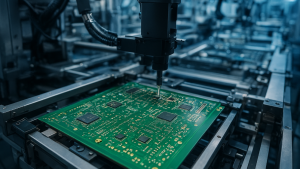
High reliability cannot be achieved through PCB design alone. The manufacturing process must maintain consistent control over materials, dimensions, layer registration, drilling, plating, etching, lamination, solder mask, and final testing.
A typical Robotics PCB Manufacturing workflow includes:
- Engineering review and DFM analysis
- Material preparation
- Inner-layer imaging and etching
- Layer lamination
- Mechanical and laser drilling
- Through-hole copper plating
- Outer-layer imaging and etching
- Surface finishing
- Electrical testing
- Final inspection
Automated inspection and electrical testing are particularly important for high-reliability robotic electronics. AOI can identify opens, shorts, line-width deviations, and pattern defects, while electrical testing helps verify circuit connectivity before shipment.
For projects requiring integrated PCB fabrication and assembly, PCBA Manufacturing and Assembly can extend the manufacturing process from bare PCB fabrication to component assembly and testing.
Designing PCBs for the Future of Robotics
The development of collaborative robots, autonomous mobile robots, service robots, medical robots, and specialized robotic systems will continue to increase PCB performance requirements.
Future robotic circuit boards are likely to require a combination of:
- Higher wiring density
- Faster signal transmission
- Better thermal management
- Greater electromagnetic compatibility
- Smaller form factors
- More flexible mechanical structures
- Higher power-handling capability
- Improved manufacturing consistency
HDI can support miniaturization, high-frequency materials can support high-speed communication, heavy copper can address power requirements, and rigid-flex structures can accommodate moving mechanical assemblies.
The most effective approach is to consider PCB architecture, materials, stack-up, signal integrity, thermal performance, mechanical requirements, manufacturing processes, and testing as one integrated engineering system.
Conclusion
A high-reliability PCB is more than a platform for connecting electronic components. In modern robots, it serves as a critical foundation for sensing, computing, communication, power delivery, and motion control.
A well-designed High-Reliability PCB for Robotics must withstand mechanical stress, temperature variation, electromagnetic interference, high-speed signals, and continuous operation. Selecting suitable materials and manufacturing technologies—including multilayer PCB, HDI PCB, controlled impedance, high-Tg materials, heavy copper, and Rigid-Flex PCB—can help robotic systems achieve greater reliability and integration.
From prototype development to production, close cooperation between PCB designers and manufacturers is essential. Early engineering review, DFM analysis, controlled manufacturing processes, and comprehensive inspection can reduce production risks and provide consistent PCB performance for demanding robotic applications.
For robotics developers looking for a manufacturing partner, GO PCB provides PCB fabrication, PCBA, engineering support, and related electronics manufacturing services for prototype, low-volume, and production requirements. Contact GO PCB to discuss your robotic PCB project and manufacturing requirements.