PCB Baking Before SMT Assembly: Temperature and Time Rules
A bare board that has been sitting in a warehouse is not ready for the reflow oven. Laminate and solder mask absorb water from the air, and when that water meets reflow temperature it turns to steam faster than it can escape. The result is delamination, blisters around holes and solder joints that blow apart. PCB baking before assembly is the control that removes that water, and the time and temperature are specified rather than guessed.
Why Moisture in the Bare Board Matters
Water uptake depends on the resin system, the storage humidity and the time since the panel was sealed. A board still inside its vacuum bag with a desiccant pack is usually fine. A board that was opened and left on a shelf for a week in a humid climate is not, even if the desiccant pack is still in the bag, because the pack has a finite capacity and stops absorbing once it is saturated.
The damage mechanism is pressure. Steam trapped inside the laminate expands as the board heats, and where the resin to glass bond is weakest, it delaminates. Around a plated hole the steam can push molten solder out of the barrel, producing a blowhole that looks like a soldering defect but is actually a moisture defect. The higher the reflow temperature, the more violent the effect, which is why lead free processes are less forgiving than tin lead ones, and the difference between the two alloys is set out in the notes on lead free versus leaded solder.
Reading a Humidity Indicator
Most board suppliers ship each bag with a humidity indicator card. The card changes colour as it takes up water and has printed thresholds, typically read at 30, 40, 50 and 60 percent relative humidity. If the card has reached its upper threshold, the boards need baking regardless of how they look and regardless of the desiccant pack. Reading the card when the bag is opened, and recording the result, is the cheapest step in the whole process and the one most often skipped.
Storage conditions decide how quickly a board reaches the point where baking is unavoidable. A controlled stock room held at 22 degrees Celsius and below 50 percent relative humidity is the normal target, and bags stay sealed until the moment they are needed. Where the humidity cannot be controlled, partial reels and opened bags are kept in dry storage cabinets with a desiccant and a humidity display, because the alternative is a bake cycle every time a board is taken out.
Bake Time by Board Age and Storage
The schedule below is the one most assembly houses use for standard FR4, and it should be confirmed against the laminate supplier recommendation for specialised materials.
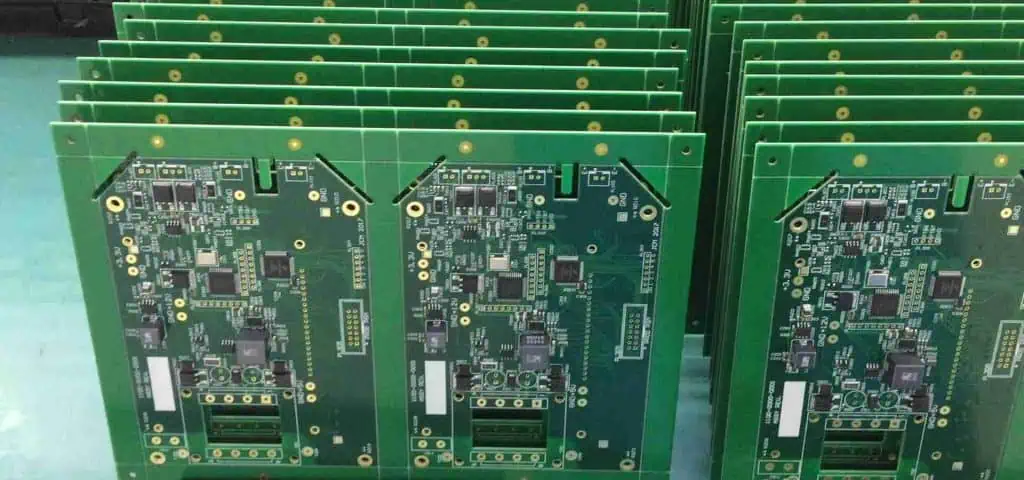
Boards manufactured within the last two months and unsealed for more than five days are baked for one hour at 120 degrees Celsius plus or minus 5 degrees. Boards with a manufacturing date between two and six months are baked for two hours at the same temperature. Boards between six months and one year old need four hours. Anything older than a year is baked for four hours and then re-tinned or given a fresh surface finish before it can be run, because the existing finish has oxidised beyond reliable soldering.
Timing starts when the oven reaches the set point, not when the boards go in, and the bake time is not a soft target. A board removed early has had its surface water driven off while the water deeper in the laminate remains. It is also worth noting that once a board has passed the 5-day window after baking, the absorbed moisture content has climbed back and a further hour in the oven is required before it goes on the line.
Stacking, Loading and Cooling
Boards are placed flat in the oven, because stacking them on edge traps moisture differently and can distort thin panels. Small and medium boards are stacked up to about 40 pieces, and larger boards about 30, with the stack arranged so that air circulates around each piece. The boards are removed within ten minutes of the cycle finishing and laid flat at room temperature to cool. Leaving them in a hot oven or stacking them while hot holds the moisture in the air gap between the panels and can leave the stack damp again.
The oven itself needs a calibration check as well. An oven that reads 120 degrees on the controller but runs cool at the centre of the load is delivering less drying energy than the schedule assumes. Placing a thermocouple in the middle of a representative stack, rather than relying on the panel meter, is a quick verification that the process is doing what the record claims it does.
Parts that will not be reused after rework do not need baking, so it is worth separating the material that is going back into stock from the material that is going into the oven.
Repeated Baking and Board Warpage
Every bake cycle is a thermal cycle, and repeated cycles embrittle the resin and increase the risk of warpage. A board that has been baked three or four times may blister on the next reflow even though each individual bake was within specification. This is why the process should bake once, for the correct time, rather than baking repeatedly for short periods as a precaution. Boards that have already been through a wash need baking because the wash itself adds water, while boards that have never been exposed to moisture and are still sealed generally do not.
Warpage also has a layout dimension. A stackup with an odd number of copper layers, or one where the copper distribution is very uneven between layers, carries a built-in imbalance that grows with each thermal excursion. Keeping the copper balanced and the stackup symmetrical reduces the effect, which is why a panel that arrived flat can be visibly bowed after a bake and a reflow cycle.
Baking Components as Well as Boards
Moisture sensitive devices need their own control. Plastic packages absorb water and are graded by moisture sensitivity level, which sets the floor life after the bag is opened and the bake conditions if that time is exceeded. The bake temperature depends on the package: parts in trays or tubes are often baked at 40 to 50 degrees Celsius for many hours rather than at 120 degrees, because the carrier would deform at the higher temperature. Carrier tape on reels has the same limitation, so reels are baked at low temperature for a long period or the parts are transferred to heat resistant trays.
Floor life is the number that matters for these parts. It is counted from the moment the protective bag is opened, and it is reset by a proper bake rather than by simply resealing the bag. Parts that have exceeded their floor life and are not baked can suffer internal cracks at reflow, which later appear as intermittent failures, and a device that has absorbed water may also move during reflow, as described in the notes on SMT component shift causes.
Documenting the Bake
The bake record is part of the traceability of the build. It should capture the board part number and lot, the manufacturing date from the panel marking, the humidity indicator reading, the oven set point, the start and end of the cycle and the operator. When a delamination defect appears later, that record is what distinguishes a material problem from a process problem, and it is also what proves the assembly house handled the material correctly. The same discipline that keeps the bake record intact is what makes a build traceable under the wider design guidelines for manufacturability.
FAQ
How long should a PCB be baked before assembly? One to four hours at 120 degrees Celsius depending on the age of the board, with timing measured from the moment the oven reaches temperature.
Do boards in a sealed bag with desiccant still need baking? Not if the package is intact and the humidity indicator card is below its threshold. Once the bag is opened, the floor life starts.
Can a board be baked at a higher temperature to save time? No. Above the recommended range the resin and the solder mask are damaged, and the board may blister before it ever reaches the assembly line.