Automotive PCB Reliability: What Robotaxi Volumes Require
A supplier recently confirmed volume production of a digital automotive lidar with more than five hundred lines of resolution and an angular resolution as fine as 0.050 by 0.025 degrees, aimed at L3 and L4 driving and at Robotaxi operation. At the same time fleets are moving from the hundreds into the thousands, with one operator reporting 1,975 vehicles by the end of June 2026, and market research projecting a Robotaxi services market worth 66.6 billion dollars by 2030. Automotive PCB reliability stops being a qualification exercise at that point and becomes a production question.
Autonomous fleets differ from ordinary cars in the density of their sensing, computing and redundancy. Each vehicle carries lidar, cameras and radar, a central computing platform and a power system, and once a fleet reaches four figures those assemblies have to be manufactured repeatedly with the same behaviour. That shift from sample approval to sustained delivery is where most suppliers are actually tested.
What the Sensor Modules Require
A digital lidar integrates laser emission, optical reception, signal processing and power control in one housing. The detector and emitter arrays are driven at high speed, the return signals are weak, and the timing between channels determines range accuracy. Boards inside that module need fine line routing, controlled impedance for the fast interfaces and careful isolation between the noisy drive section and the sensitive receive path.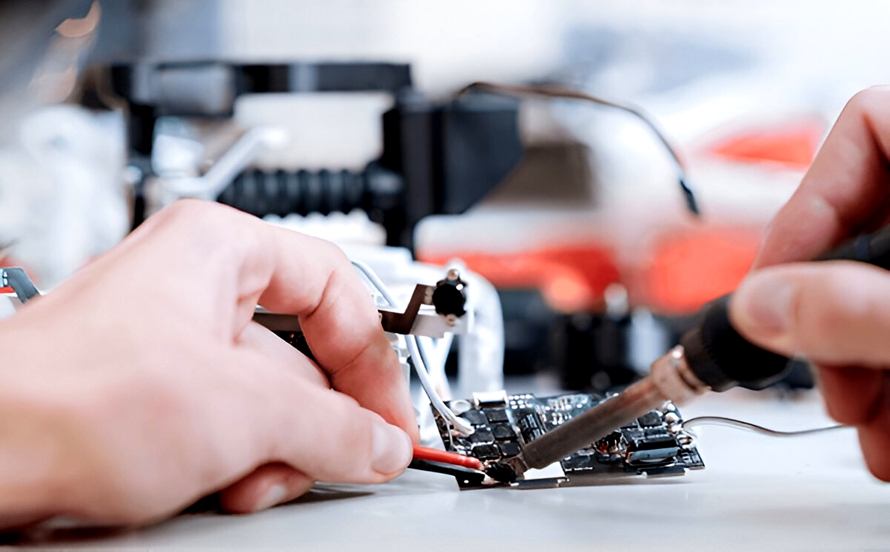
Resolution improvements make that harder. More channels and finer angular discrimination mean more data per second and tighter tolerances on the timing of each channel, so the board contributes directly to measurable performance rather than only to connectivity. That is why sensor modules have become a demanding application for fine line and HDI fabrication rather than a routine build.
The Central Computing Platform
High performance driving computers use processors with large ball grid arrays, high speed memory and multiple camera and ethernet interfaces, which pushes the board toward sixteen layers and above. Routing the escape from such a package requires microvias, and maintaining signal integrity across long differential channels requires continuous reference planes and disciplined stack up planning.
Thermal design follows the same logic. A processor that runs continuously under load dissipates heat into the board, and the power distribution network has to deliver current without excessive voltage drop while spreading heat into the enclosure. Boards of this class are usually specified with impedance tolerances and thermal requirements that are verified during design rather than discovered at test.
Power Electronics and Thick Copper
Electric vehicle platforms running at eight hundred volts still move significant current, and battery management, motor control and charging circuits all require conductors sized for current rather than for signal. Thick copper layers, wide planes and thermal vias are used together, and the board often doubles as part of the thermal path.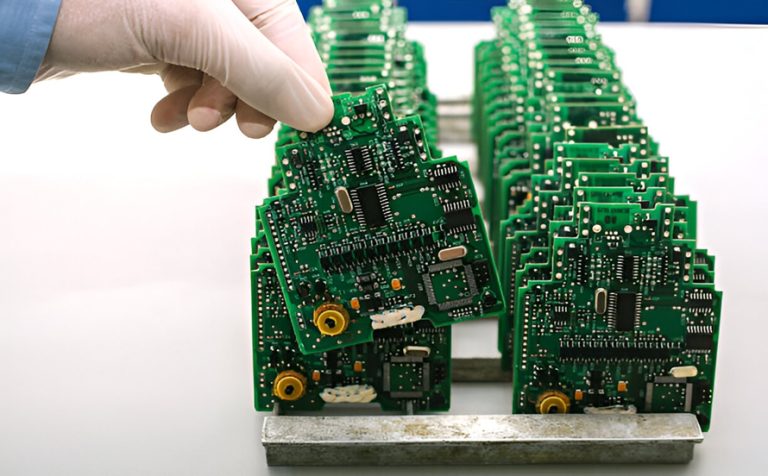
Thick copper and fine line capability conflict on the same panel, because etching heavy copper cannot produce narrow traces. Designs resolve this by separating power and control sections, sometimes on different boards, and by accepting joints between them. Getting that partition right during architecture definition avoids a redesign in the middle of a vehicle programme.
Why Zero Defects Is a Statistical Claim
Automotive customers speak about zero defect delivery, but no inspection process achieves it by looking harder. The claim is really about process capability: a process whose variation is far inside the specification limit produces very few defects, and one that is merely capable produces failures that appear after shipment.
That distinction has procedural consequences. Suppliers are expected to demonstrate capability indices, to apply statistical process control on critical parameters such as impedance, plating thickness and registration, and to react to trends rather than to failures. It is a different operating discipline from making a sample that passes, and it is what an automotive quality system is designed to enforce.
Traceability From Fleet Back to Batch
When a vehicle in a fleet develops a fault, the operator needs to know which other vehicles may share the cause. That is only possible if the assembly can be traced to the board lot, the component lots and the process conditions under which it was built. Traceability is therefore a customer requirement rather than an internal practice.
Building it means lot control at incoming inspection, serialisation or date coding at assembly, and retention of test data against the unit rather than against the work order. It also means that changes are recorded, because a substitution made for supply reasons can invalidate the comparison between two batches.
Reliability Testing Beyond the Datasheet
Automotive assemblies are qualified against thermal cycling, vibration, humidity and electrical stress, and the failures that emerge are often at interfaces: solder joints on large ceramic components, plated barrels in thick boards, and flex terminations where a cable meets a connector.
Effective qualification therefore combines board level tests with assembly level tests. Solder joint reliability under thermal cycling is an assembly property, not a board property, and impedance stability is a board property that assembly can disturb through warpage. Treating the two as a single reliability programme is what allows a supplier to predict behaviour in the field rather than explain it afterwards.
Field Failure Analysis and Feedback
Fleet operation provides something a laboratory cannot: a large population accumulating real mileage under real conditions. When a failure occurs, the value lies in how quickly the cause can be isolated to a design issue, a manufacturing excursion or a supplier component, because that determines the size of the recall or retrofit.
Suppliers who support this well keep failure analysis capability and communicate results rather than defending conclusions. Over the life of an autonomous vehicle programme, that feedback loop is what improves yield and reduces warranty cost, and it is more valuable to a customer than a marginally lower unit price.
Capacity Discipline in a Growing Market
Autonomous driving hardware is expanding quickly, and capacity that is added quickly is often capacity that is added without full process qualification. That is the main technical risk in a rising market: a supplier wins volume and discovers that yield on the demanding product is lower than the pilot suggested.
Buyers can protect themselves by qualifying capacity rather than sites. Ask what yield was achieved on comparable automotive products over the last four quarters, what process changes were made in that period, and how the changes were validated. Suppliers with answers to those questions are managing growth, while those without are hoping that it works.
Supplier Qualification for Autonomous Programmes
Qualifying a supplier for autonomous driving hardware is a project in itself. It involves process audits, capability studies on the specific construction, sample builds that are tested to destruction, and a documentation trail that shows how each requirement was verified. The effort is justified because a defect that reaches a fleet has consequences beyond warranty cost.
What suppliers should expect to demonstrate is depth rather than breadth: how their process behaves on the exact product, what limits they know, and how they detect drift before it produces failures. Buyers benefit from asking the same question twice, at the start of qualification and again after volume begins, because capacity growth is where process discipline usually weakens.
When the Design Changes Mid Programme
Autonomous vehicle platforms change faster than conventional automotive programmes. Sensors are upgraded, computing platforms are replaced generation by generation, and each change alters the board. Managing that requires a change control process that answers two questions: what exactly changed, and what has to be revalidated as a result.
Boards that were designed with generous margins survive these transitions; ones that were tuned to the limit do not. Allowing margin in impedance tolerance, thermal headroom and layer count makes a revision a modification rather than a restart, and it is the cheapest insurance available on a programme that will not stand still. Suppliers involved early in layout and stack up decisions can usually point out where that margin is worth keeping.
What Reliability Actually Costs
Automotive grade boards cost more than consumer boards, and the difference is spent on material stability, tighter process control, additional inspection and documentation rather than on anything the driver can see. Comparing an automotive quotation with a consumer one on unit price alone therefore measures nothing useful.
The right comparison is cost per vehicle over its operating life, including the probability of a field failure and the cost of handling it. On that measure, the additional inspection and the slower, better controlled process are inexpensive, and the argument for them becomes easier to make to a commercial team when the alternative is a fleet level retrofit.
Coordinating Board, Assembly and Test
An autonomous vehicle programme involves several board types: dense sensor boards, high layer count computing boards and thick copper power boards. Each follows a different process route, and each brings its own yield behaviour and inspection requirements.
Keeping them within one manufacturing chain makes the interfaces easier to manage, since tolerance and material decisions are made with visibility of all three. It also shortens the response when a change is needed, which matters in a product category that is still evolving rapidly. For programmes at this stage, that coordination is usually worth more than a narrow difference in unit price, and it is the practical reason to evaluate a supplier on the whole process rather than on a single capability.