AI Server PCB Demand: What a 95 Billion Dollar Backlog Means
Analysis published at the end of August 2026, based on the latest quarterly results from Dell, put AI optimised server revenue at 16.4 billion dollars for a single quarter, roughly double the prior year, with full year guidance raised from 167 billion to 192 billion dollars and an AI server backlog reported at 95 billion dollars. For AI server PCB demand the important detail is not the growth rate but where it appears: in the value of the electronics inside each rack rather than only in the number of machines shipped.
Traditional servers are built around processors, memory and storage. An AI server adds accelerator modules, high speed interconnect boards, faster network adapters and a much more elaborate power system. Board count, board area and technical grade rise at the same time, and the printed circuit stops being a passive connection medium and becomes part of the performance budget.
Why Rack Value Grows Faster Than Shipments
Each accelerator needs power delivery, cooling and a high bandwidth connection to its neighbours, and those connections run across boards rather than through cables. As interconnect density increases, the routing that carries it becomes the limiting design element, and the boards grow in layer count and material grade.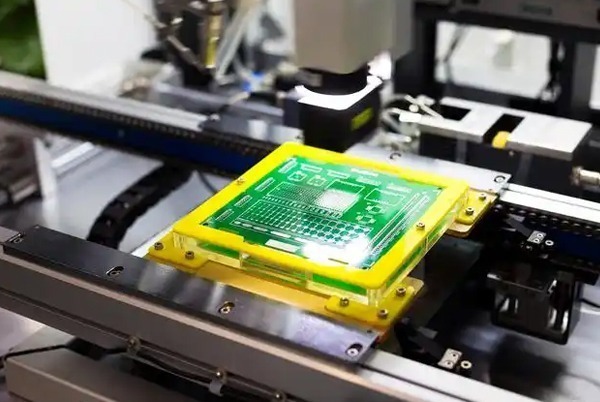
The result is that the same physical number of racks consumes considerably more board value than it did two years ago. Analysts measuring this have estimated that a single high end rack now carries board content worth several times what the previous generation did, driven by additional board types rather than by a price increase on existing ones.
Layer Counts Move Past Sixteen
Accelerator servers have pushed mainstream server boards beyond sixteen layers, with compute boards, switch boards and backplanes reaching thirty or forty layers in current designs. In the most demanding interconnect applications the industry is discussing structures approaching eighty layers.
Layer count rises because signal, ground, power and control functions can no longer share space. Every high speed channel needs a reference plane close to it, every power domain needs a plane capable of carrying current with low impedance, and the escape routing from large packages consumes layers quickly. High layer count is therefore a signal integrity and power integrity requirement rather than a marketing figure.
Material Grade Follows Bandwidth
Data rates inside these systems have moved to the point where dielectric loss and copper roughness consume a meaningful share of the channel budget. Low loss laminates, and in some designs ultra low loss grades, are specified for the layers that carry the fastest signals, while other layers use less expensive material.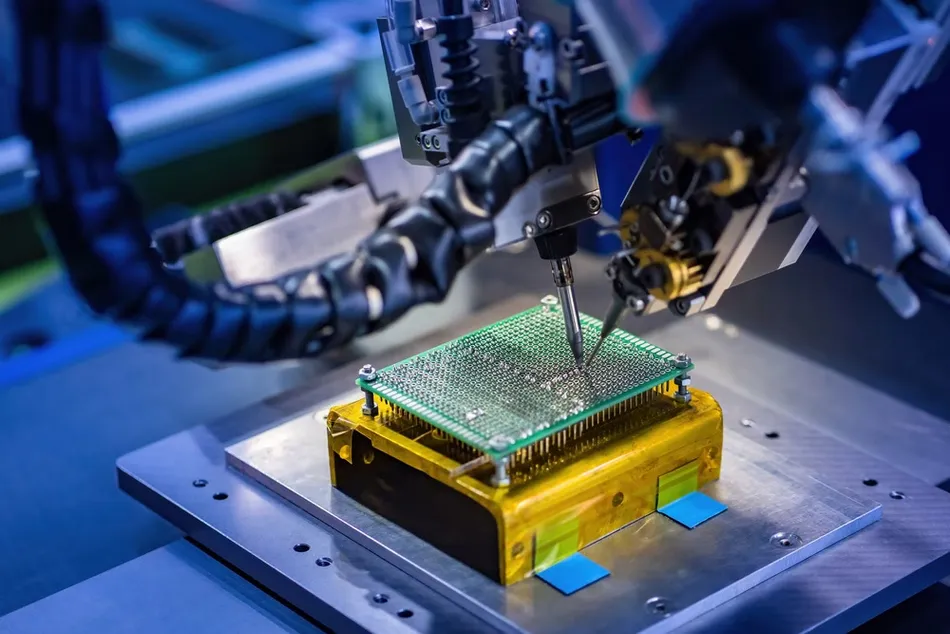
Mixed stack ups control cost but add process difficulty, because different materials expand at different rates during lamination and their dielectric thickness behaviour under pressure differs. Manufacturers building these boards have to characterise the combination rather than rely on the properties of a single material, which is why process control in fabrication becomes a purchasing criterion.
Power Delivery at Accelerator Scale
An accelerator package can draw several hundred amperes at a low voltage, and the power distribution network has to deliver that current with minimal voltage drop and minimal inductance. Copper weight increases, and in some designs copper is embedded in the board to provide cross section without excessive layer count.
Decoupling placement then becomes a layout problem with a strong physical component, because the distance between a capacitor and the die determines its effectiveness. Designers place capacitors beneath the package using microvias for the shortest possible path, which is one of the reasons advanced HDI techniques have entered server boards that were previously conventional constructions.
Backplanes and Midplanes
Racks connect accelerators through backplanes and midplanes that combine very high layer counts with long high speed channels. These boards are thick, they carry thousands of differential pairs, and they must maintain impedance within a tight window across the full length of each channel.
Manufacturing difficulty scales with both dimensions. A long channel accumulates the effect of every local variation, so line width control, dielectric consistency and registration all influence whether the channel meets its loss target. Backplanes are also mechanically large, which makes panel handling and thickness control significant process variables.
Interconnect Standards Push the Specification
PCIe generations and coherent interconnect standards such as CXL raise data rates while adding requirements for latency and signal integrity that affect the board design directly. Compliance testing at these rates is unforgiving, and a small impedance discontinuity that would once have been invisible can now push a channel out of specification.
Designers respond with stricter stack up rules, matched via transitions, back drilling where stub effects matter, and impedance specifications verified by coupon measurement. Each of those measures requires manufacturing capability, and each of them adds cost that is justified only when the channel actually needs the bandwidth.
Thermal Load in a Dense Rack
Boards inside an accelerator rack operate in an environment already managing hundreds of watts per node, so the board sees elevated ambient temperature as well as its own dissipation. Material selection then has to consider thermal ageing behaviour, not only electrical loss, because the dielectric properties must remain stable over years of operation.
Thermal vias under power devices, copper planes tied to heatsinks and a stack up designed to conduct heat away from hot spots are all normal requirements. Where the board also carries the mechanical load of a heavy heatsink, warpage control during assembly becomes part of the reliability assessment rather than a cosmetic concern.
Capacity, Lead Time and Qualification
Demand at this scale has created a market where high layer count capacity is genuinely scarce. Lead times for demanding constructions have lengthened, and buyers have discovered that the constraint is not throughput alone but the number of factories able to hold yield on a forty layer board with low loss material.
Qualification is the reason that capacity cannot be added quickly. A new production line has to prove its process capability on comparable products before a server customer will route volume to it, and that evaluation takes months. Buyers should therefore treat lead time commitments with the same scrutiny as price, and ask how much of the quoted capacity is already qualified for their product class.
HDI Techniques Enter the Server Board
Server boards were historically conventional multilayer constructions. As package pin counts and interconnect density rose, microvias and fine line routing became necessary for escape routing and for placing decoupling where it is effective, so advanced HDI techniques now appear in products that would once have been built with standard processes.
That combination, high layer count plus microvia density plus low loss material, is the most demanding overlap in commercial board manufacturing. It requires a factory to control laser drilling, plating fill, registration and impedance simultaneously, and it explains why only a subset of capacity can serve this market even when total capacity looks adequate.
Test and Inspection on Thick Boards
Thick, high layer count boards are difficult to inspect. Optical methods cannot see inner layers, X-ray inspection becomes less penetrating as copper weight rises, and electrical test fixturing has to accommodate fine pitch and high net counts. Test strategy therefore has to be designed alongside the board rather than added at the end.
Coupon structures measuring impedance, dielectric thickness and registration give process feedback during production, while continuity and functional tests verify the finished assembly. Where back drilling is used, depth verification is a separate step that needs its own measurement. Planning that coverage with the fabricator and the assembly house together keeps the data comparable, which is the practical reason to use coordinated testing.
Material Supply Pressure
Low loss laminate demand has grown faster than the capacity to make it, and the raw materials behind it include the same glass fabric and copper foil that the rest of the industry consumes. Prices for high performance copper clad laminate have risen sharply as a result, and lead times have extended on specific grades.
For server programmes this makes material planning a long lead activity. Qualifying a second material family early, forecasting further ahead and accepting formula based pricing are all practical responses, and they belong with supply planning rather than with the electrical design. A supplier who can show which grades are secured, and for how long, is describing the part of the chain that actually determines delivery.
What Buyers Should Verify
Three questions separate capable suppliers from optimistic ones in this market. What is the highest layer count in routine production rather than in a demonstration. What yield has been achieved on boards with low loss materials and comparable channel counts. And how is impedance verified across a panel, with what data retained.
Ask also about back drilling and depth control if the design requires it, since that process affects both signal behaviour and yield, and about the inspection stages applied to thick boards where optical methods are limited. A supplier that answers precisely is describing a manufacturing system, and that is the substance behind a capability claim for this class of product.