PCB Skin Effect on High Frequency Traces: Running on the Surface Electronics manufacturing has become a discipline of small details. Solder paste volumes, placement accuracy, temperature profiles and inspection limits all add up to the final result. This guide looks at PCB skin effect on high frequency traces from the…
Through-Hole PCB Assembly Cost: What Drives It Why Through-Hole Assembly Costs More Than SMT A surface mount joint is made by a machine that places a component and an oven that solders a thousand joints at once. A through-hole joint is made by inserting a lead into a hole and…
PCB Hybrid PTFE FR4 Bonding: Getting Two Plastics to Stick Modern electronics depend on boards that are assembled correctly the first time. Every product – a phone, a charger, a medical instrument or an industrial controller – relies on thousands of solder joints that must conduct current for years. This…
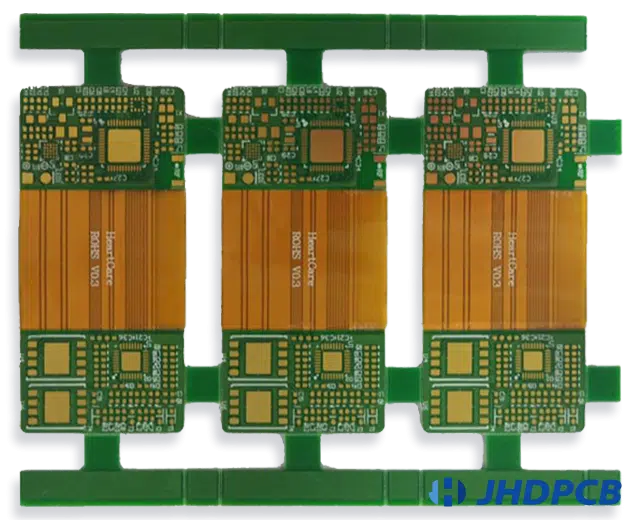
Single-Sided vs Multilayer Flex PCB: Which to Choose The Choice That Sets the Whole Project A flexible circuit is specified for a reason, usually that the product has to fold, bend or conform to a shape. Once that is decided, the next question is the layer count, and it is…
PCB Mixed Material Stackup: Two Materials in One Board Buyers and engineers often focus on the finished product and forget the production line behind it. In practice, most field failures can be traced back to process decisions made during assembly. Understanding PCB mixed material stackup gives you a practical advantage…
Rogers 3010 PCB: The High-Dk Material Explained A Material Chosen for Its Dielectric Constant Most laminate decisions are made on temperature, cost and loss. Rogers 3010 is chosen for a different reason: it has a dielectric constant of about 10.2, which is more than twice that of ordinary FR-4 and…
PCB Glass Weave Skew: When the Weave Slows One Trace Electronics manufacturing has become a discipline of small details. Solder paste volumes, placement accuracy, temperature profiles and inspection limits all add up to the final result. This guide looks at PCB glass weave skew from the perspective of a PCBA…
PCB Miniaturisation: Principles, Limits and Cost What Miniaturisation Means in Practice Miniaturising a board means fitting the same circuit into less area, less thickness or less weight, without giving up performance. It is not one technique but a set of them applied together, and the useful ones depend on what…
PCB Stackup Symmetry: Building the Same on Both Sides Electronics manufacturing has become a discipline of small details. Solder paste volumes, placement accuracy, temperature profiles and inspection limits all add up to the final result. This guide looks at PCB stackup symmetry from the perspective of a PCBA factory floor,…
How Much Does It Cost to Build a PCB Factory? What the Question Really Asks Building a printed circuit board factory is a capital project with three distinct cost blocks: the initial investment to build and equip the plant, the monthly cost of running it, and the working capital needed…