PCBA Capability: How to Judge a Manufacturer Process
Two assembly houses can quote the same board within a few percent of each other and deliver very different products, because the quotation says nothing about the capability behind it. PCBA capability is measurable, though: it shows up in the smallest package a line can place reliably, in the inspection equipment on the floor, in how test coverage is designed and in whether the process leaves a record behind. This article explains which capabilities actually predict a good outcome.
Placement Capability on the SMT Line
The first indicator is the smallest component the line handles routinely. A capable line places 01005 parts, roughly 0.4 by 0.2 mm, at production yield, not just in a demonstration. Placement accuracy in the region of 25 microns and throughput around 50,000 components per hour describe modern equipment, but the number that matters is the one achieved on a real product with real changeover pressure.
Supporting the placement machine matters just as much. Solder paste inspection after printing catches volume errors before parts are placed, which is far cheaper than catching them after reflow. Inline automated optical inspection verifies that components are present, correctly oriented and within position tolerance, and a line that runs both inspection steps in line has closed the loop between printing and placement rather than relying on a final check.
Through-Hole and Mixed Technology
Through-hole work still appears on power boards, connectors and anything that has to survive mechanical load. Wave soldering handles high volumes, selective soldering handles mixed technology boards where reflow parts must not see the wave, and hand soldering covers the small number of joints that no machine can reach. A manufacturer that can run all three in one process flow avoids sending the board back and forth between vendors.
Mixed technology integration is the real capability test. When a board carries fine pitch reflow components on one side and a press fit connector or a heavy inductor on the other, the sequence of paste printing, placement, reflow, selective soldering and cleaning has to be planned so that no step damages what came before. That planning is engineering work rather than equipment, and it is where a capable supplier separates from a fast one.
Inspection and Test Coverage
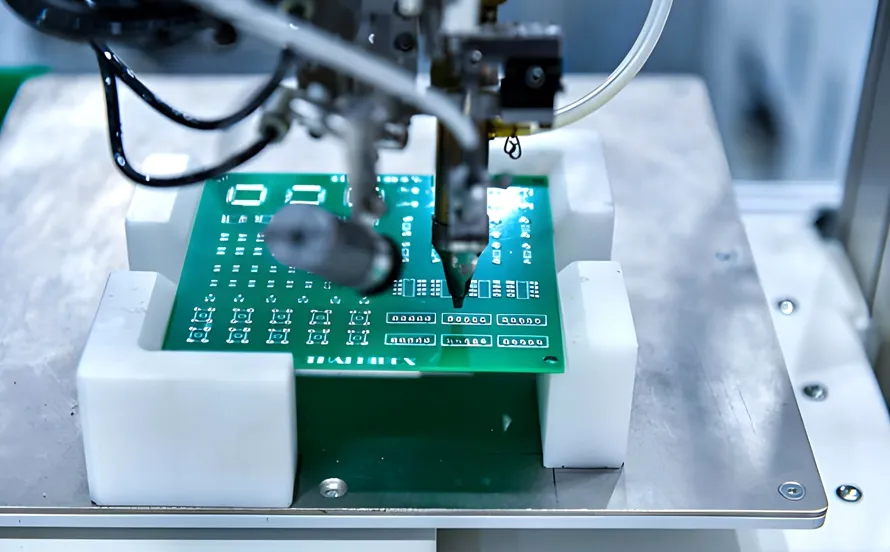
Inspection has three layers. Automated optical inspection covers visible joints, polarity and placement on the assembled side. X-ray inspection covers what cannot be seen, including voiding and insufficient solder under ball grid arrays and quad flat no-lead packages. Electrical test then verifies function: in-circuit test checks continuity, resistance and component values, while functional test exercises the board in conditions close to its real use.
The critical question is not which machines are present but how the test limits were derived. A functional test built from the design specification is a real screen; one built from a known good board only detects deviation from that unit. Asking how a test programme is developed, and whether it is version controlled alongside the product, is a fast way to judge PCB design quality characteristics translated into production control.
Engineering Support
Manufacturability review is the most valuable service an assembly house provides, and it happens before production. A review that examines pad geometry against package footprints, panel orientation, thermal relief on large copper areas and the clearance needed around connectors will find problems while they are still cheap to fix. The same review should check the bill of materials for obsolete or long lead parts and propose alternatives with equivalent specifications.
Prototype turnaround is a useful capability indicator because it exposes process flexibility. A supplier able to deliver first articles in three to five working days is doing so with planned capacity and an established flow rather than by interrupting production. That flexibility also predicts how the supplier will handle an engineering change late in a program, which is when schedule pressure is greatest. Releasing files that follow the design rules in PCB design guidelines for manufacturability removes most avoidable queries before they ever reach the line.
Scale, Flexibility and Traceability
Volume flexibility cuts both ways. A shop that runs ten thousand units a week may struggle with a ten piece order, and a prototyping specialist may not have the process controls needed for volume. The useful capability is the ability to move from small batch to production on the same controlled process, so that the boards qualified in the prototype phase are representative of what ships later.
Traceability is the quiet capability. Every board should be linked to the material lots, process parameters and test results for its build, because that record is what makes a field failure analysable. Where a program involves scheduled deliveries or vendor managed inventory, Kanban and just in time arrangements are also part of the capability, since they require the supplier to hold both process control and schedule discipline.

Certification and Standards
Certification is a floor rather than a differentiator. ISO 9001 describes a quality management system, IATF 16949 adds the automotive requirements, and ISO 13485 covers medical devices. RoHS and UL address materials and safety. Process standards matter equally: IPC-A-610 defines the acceptance criteria for assembled boards, and a supplier that works to Class 2 by default and Class 3 where required is operating at the level most industrial and medical programs expect.
Certificates should be verified rather than assumed. Asking for the current scope of the certificate, the site it applies to and the date of the last surveillance audit takes a few minutes and removes a category of risk. A supplier that cannot answer those questions quickly is unlikely to produce the traceability records a customer audit will later require. Documentation should also be current, since the standards themselves are revised every few years.
Assessing a Supplier Before Committing
Four practical steps cover most of the risk. Ask for the smallest package the line places at production yield, and for the process capability data behind it. Ask which inspection and test stages are inline and which are sampling based. Ask for an example of a manufacturability issue the supplier found and how it was resolved. Finally, ask how material lots and process parameters are recorded and how long the records are retained.
A partner such as gopcb answers those questions in writing and runs the same process from prototype through volume, which removes the discontinuity that appears when a design is transferred between suppliers at the worst possible moment. That continuity is usually worth more than a few percent on the unit price.
FAQ
What is the smallest component a capable assembly line should place? A production line should handle 01005 packages, about 0.4 by 0.2 mm, at yield. Anything above that is a limitation worth knowing before the design is released.
Is X-ray inspection necessary for every board? Not for every board, but it is essential wherever ball grid arrays, land grid arrays or quad flat no-lead packages are used, because those joints cannot be inspected optically.
Why does traceability matter if the product works? Because a field failure can only be analysed if the board can be linked to its material lots, process parameters and test data. Without that record, every failure becomes an expensive investigation.