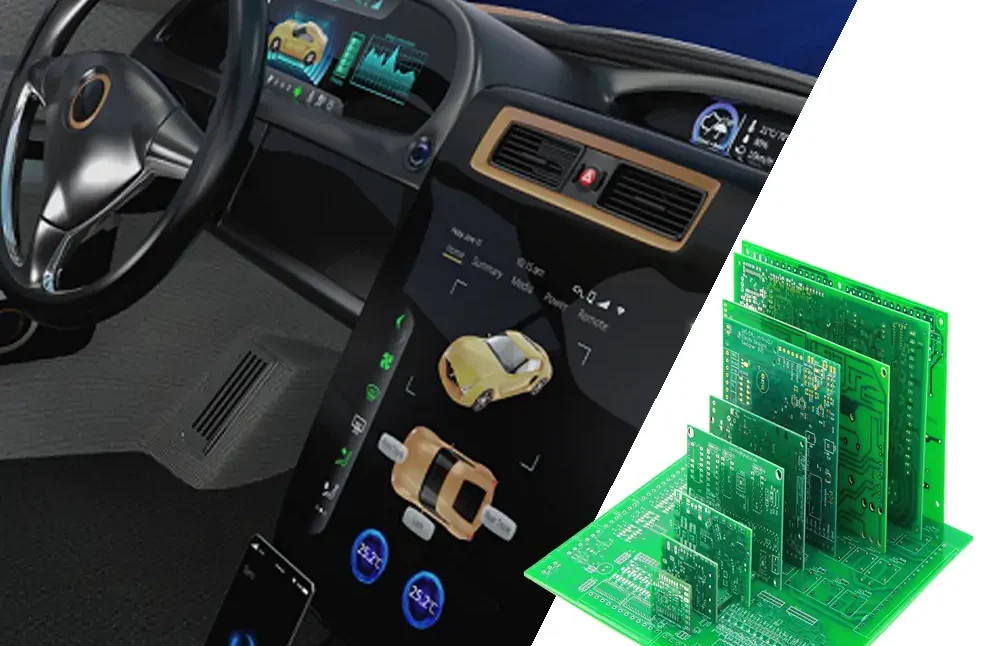
Automotive PCB Requirements: Heat, Vibration and Validation An automotive PCB looks like an industrial board with a longer specification, and that impression is misleading. The difference is not the number of tests but the environment the board has to survive between them: a car climbs mountains, fords water, sits in…

Navigation PCB: GNSS Receiver Layout and Design A navigation receiver listens for signals that arrive from satellites twenty thousand kilometres away, after passing through the atmosphere and through the product’s own enclosure. The signal at the antenna is well below the thermal noise floor of the receiver, and the position…
DXF Files in PCB Design and Manufacturing Gerber data describes the electrical side of a board: copper, mask, legend and drill. It says very little about mechanical intent, and on a board with an unusual outline, an internal cut-out or a connector that has to sit in a precise recess,…
Rail Transit PCB: Vibration, Temperature and Long Life Rolling stock electronics are specified for a service life measured in decades, in an environment that combines continuous vibration, wide temperature swings, humidity and an electrical supply that is anything but clean. A rail transit PCB therefore resembles an industrial board in…
More Layers Is Not Always Better: Choosing a PCB Layer Count More layers is better is one of the oldest assumptions in board design, and it survives because a thicker stack-up does make some problems easier. The assumption breaks down as soon as cost, manufacturability and thermal behaviour are considered,…
Solder Wetting Problems: Why Solder Fails to Spread Solder that refuses to spread is one of the most disruptive faults on a production line, because the board is finished, the components are placed and the defect only becomes visible at the point where it is most expensive to correct. Poor…
High-Density Multilayer PCB: Why Fabrication Gets Harder A high-density multilayer PCB is not simply a board with more layers. It is a product where the substrate, the layer-to-layer connection, the copper finish, and the inspection plan all have to be right at the same time, and where a defect in…
High-Speed PCB Layout Rules That Actually Matter Most high-speed PCB layout problems do not come from a single trace. They come from the interaction between circuits that were each designed correctly on their own but were never separated on the board. The rules below are the ones that recur in…
Standard PCB vs HDI PCB: Process Capability Compared Process capability is the set of minimum features a fabricator can produce reliably, and it is the number that decides what a design can contain. A conventional board built with mechanical drilling and standard etching sits at one end of that scale;…
MRI PCB Design: Low Noise, Channel Count and Reliability Magnetic resonance imaging is one of the most demanding electronic environments in medical equipment. The magnet is always on, the gradient coils switch hundreds of amps in milliseconds, the radio frequency transmitter puts kilowatts into the bore, and the receiver is…