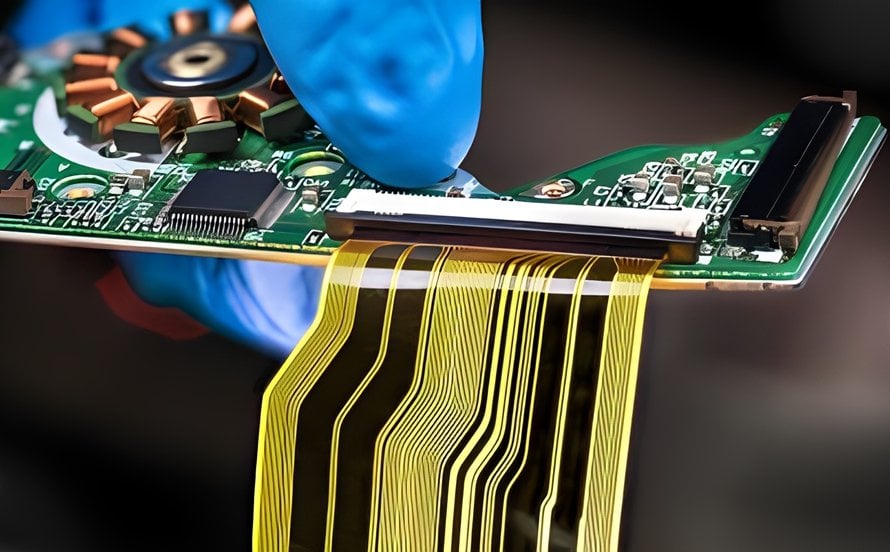
Copper Plating Defects in PCB Fabrication Acid copper electroplating occupies a central place in board fabrication. The quality of the copper plating determines the quality and the mechanical properties of the copper layer, and it propagates into everything that follows, which is why controlling it is one of the harder…

Ultra-Thick Copper Multilayer PCB Manufacturing Boards built for high current are a distinct product family, and they have grown from a specialist curiosity into a sizeable market. They are used wherever heavy current must be transmitted and where power and signal connections have to coexist on the same assembly, and…
Conformal Coating: Why Circuit Boards Need It A conformal coating is a thin protective layer applied over a finished assembly. It goes by many names — protective lacquer, coating compound, moisture-proof varnish, insulating varnish, anti-corrosion and salt-spray varnish, dust-proof lacquer — and it is expected to deliver the properties those…
Radiated EMI in Automotive Power Supply Layout Board layout decides the fate of every power supply. It determines whether the circuit functions, how much electromagnetic interference it emits, and how hot it runs — and it does all three at once. Switching regulator layout is not a mystery and it…
Component Package Types: From DIP to BGA and CSP Every integrated circuit needs a way to get its tiny internal connections out to the world, and the component package is that interface. It carries the die’s pads out to external terminals, and the terminals connect through the board’s conductors to…
SMT PCB Design Principles: Placement and Pads Design for manufacture sounds like a management concept until it is applied to a specific pad on a specific board. The rules below are the ones that decide whether an assembly runs cleanly through reflow and wave soldering, or comes out with tombstoned…
Micro PCB Design: Fine Lines and Microvias Line widths that were once exotic are becoming ordinary. A designer who a few years ago worked with a 75 micrometre minimum — three thousandths of an inch — may now be asked for 30 micrometres or less, which is roughly a thousandth…
Ground Design in Electronic Equipment: Types and Rules Ground is the least glamorous net on any schematic and the one most often responsible for a product that works on the bench and misbehaves in the field. Good ground design serves two purposes, and it is worth stating them plainly: it…
Underfill for Chip Scale Packages: When and How Chip-scale assembly has blurred a boundary that used to be neat. Flip chip and chip scale packages sit directly on the board, and the traditional separation between the semiconductor die, its package and the assembly process has largely disappeared. The advantage in…
Board Bring-Up: Debugging a Newly Assembled PCB A newly assembled board is a hypothesis, not a product. Debugging it is straightforward when the board is small and miserable when it is large and densely populated, because there are too many possible faults to test one at a time. A disciplined…